

Parents are welcome – and in fact are encouraged – to speak to our staff. There are a number of ways you are able to communicate with us:
- In person
- Phone (9274 9920)
- By email
- SEQTA Direqt Messages
If you have any concerns, please contact either your child’s teacher or Mr Jun Vasquez, who is the Head of Mathematics.
- Mr Jun Vasquez – Head of Mathematics
- Mrs Mynie van Wyk – Teacher
- Mrs Rebekah Scott – Teacher
- Mrs Donnah Holloman – Teacher
- Mr Daniel Haynes – Teacher
We also encourage students to contact their teacher either in class, at the Maths Office (Room S4.6), SEQTA Direqt, or emailing their teacher. If students have questions they are struggling with, they can either ask during the next class or send a picture to the teacher showing what they have done so far and where they are stuck. Staff will respond to these emails as soon as they are able to – please be aware that staff are only expected to check and respond to emails between 8:15am and 3:30pm Monday to Friday (excluding school holidays).
In Maths at Rehoboth, we believe homework is important because it enables students to:
- continue learning outside of the classroom, especially to finish work given in class;
- consolidate newly acquired knowledge, revise prior learning, and practise skills;
- develop the self-discipline, perseverance, and confidence to study independently; and
- involve parents in their learning.
In Years 7-8 students are expected to spend a minimum 10-15 mins on homework for every period of Maths (five periods per week).
In Years 9-10 students are expected to spend 20-30 mins on homework per period of Maths (five periods per week).
These times are guidelines. Leading up to tests and exams, students must recognise that the more time they spend working independently, the greater their chance of success. There may also be occasions when students need to put in a little more time, especially if they have not used their class time effectively or they have missed a class due to an absence or excursion.
In 2023, our online maths platform will change from Cambridge GO (formerly HotMaths) to MathSpace.
We have decided to move away from the website which is supported by the Cambridge textbook we use in Years 7-10 towards an interactive website created by Maths teachers, called MathSpace. MathSpace is an excellent resource that will support student learning of class content, help teachers to assign and check homework, and to assess each student’s skill level, helping them to complete assigned tasks and further develop their skills and understandings as well as identify any gaps in their understanding and help support them in this area.
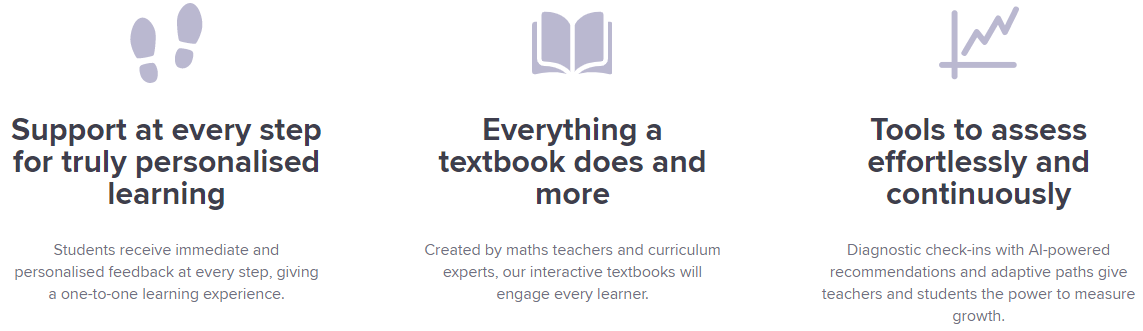
We have been trialling the MathSpace website over Terms 3-4 this year, so students already have access to all of the MathSpace features. As of 2023, every Year 7-10 student will have access to MathSpace.
If you would like more information about the program, please visit MathSpace.
With this decision, it will be optional for students to access Cambrige GO in 2023 and thus it will not be used for set homework. However, we would still recommend using it, as a PDF of the textbook is provided, along with videos of all worked examples at the beginning of each exercise. Quizzes and walkthroughs can also be used to consolidate learning. If you have purchased a new copy of the Cambridge textbook you will have received free access to CambridgeGO; however, if you are using a secondhand copy, you can choose to purchase the Digital Reactivation Code through Campion Education or Cambridge GO.
To have the best success in class students need to bring the following items to each Maths class:
- A4 notebook with lines or square grid paper;
- Cambridge textbook (physical copy);
- Surface Pro;
- Stationery: pencil, blue or black pen, red pen, and ruler; and
- Calculator: scientific or CLASSPAD (for Year 10.1 and Year 10A).
It is important that students bring these items to class, especially their calculators. As different calculators have slight differences in the way they operate, it is important that each student get to know how theirs works. The scientific calculator we recommend is the Casio fx-82AU PLUS 2nd Edition, as this is the calculator the teachers will use in class.
If a student misses a class it is their responsibility to catch up on what is missed. This includes if they miss a class because they are participating in IMP, an excursion, a carnival, or another school activity. Students should first check SEQTA to see what has been covered in the lesson and contact the teacher for any notes or worksheets they have missed.
To assist students in understanding the concepts they have missed, they can watch the videos for the worked example for the exercise on Cambridge GO.
If the student still does not understand the concept, they should ask their teacher during the next lesson or they can attend Maths Tutoring on Mondays after school in the LRC where a Maths teacher is available to explain the concept and answer questions.
It is important that students catch up as much as possible before returning to school as concepts in Maths often build upon one another, making the next lesson difficult to understand if they have not worked to understand the previous concepts taught.
Monday afternoons during term time, 3:15-4:00pm
In Week 2 to Week 9 of each term, students can go to the LRC after school to work on their homework and/or Maths assessment. A Maths teacher is available to answer questions. To get the most out of this time, it is best for students to have questions ready to ask or concepts they would like the teacher to go through with them.
If a student has an IMP lesson when an assessment is planned, it is their responsibility to arrange an alternate lesson time so that they are available to complete the assessment. If an assessment is missed due to absence, a letter from the parent to the teacher is required outlining the reason for the absence, or a medical certificate can be provided. This is required over and above the usual procedure for advising us of absences as we are required to audit the reason for the missed assessment. Students need to be come prepared to complete the assessment in their next lesson after returning to school.
There are four types of assessments commonly used in Years 7-10 Maths:
Short Assessments
These may take the form of:
- Homework: complete the homework that has been set or noted in SEQTA as well as Cambridge GO quizzes.
- Cambridge GO quizzes: These can be founded under each section of the interactive textbook. Students will need to complete at least two quizzes for each section. For a quiz to be considered complete, a minimum of four questions must be answered. These quizzes are due at the end of each chapter.
- MathSpace Assigned Tasks (online).
- In-class quizzes.
- Progress quizzes (in the Cambridge textbook).
- Chapter Reviews: These can be found in the Cambridge textbook and are required as a form of revision for tests. Students need to complete all the questions in the Chapter Review from the sections covered in class. Once completed, the student will then need to mark their own answers. If the student does not understand how to complete a question, it should not be left blank – contact their teacher or a friend for help. If the student cannot answer the question in the review, they will not be able to answer it in the test!
- Applicable Pathways: Each exercise has four sections, Fluency, Problem-Solving, Reasoning, and Enrichment. The pathways are listed at the top of each section (Foundation, Standard, and Advanced), with the questions students need to attempt listed in each column. If a students is instructed to complete half of their Applicable Pathway, they will need to attempt half of the questions listed in that column.
The mark awarded for short assessments is more about the students being diligent in completing their work and is used to promote effective study techniques to gain a greater understanding of the content covered. Marks for these assessments are collected over the course of the year and collated at the end of each semester (thus, they are not updated weekly on SEQTA).
Tests
Tests are usually based on 1-2 chapters at a time with a focus on assessing the curriculum point (on the chapter title page in the Cambridge textbook). There may therefore be times when a concept is worked on in class but does not appear in the test. This is because the test is aimed at consolidating understandings from previous years before moving on.
There are questions in each test where the context of the question is unfamiliar; however, students have been taught the mathematical concept required to solve it.
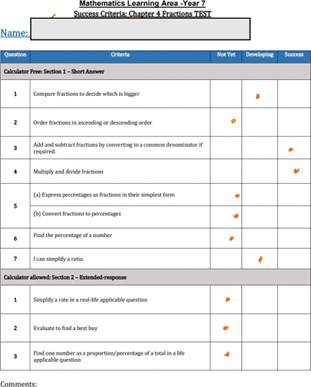
Each test result will be visible to students and parents on SEQTA along with a Success Criteria document, which allows students and parents to see individual skills a student might need to work on. Every test is also sent home for 1-2 days for the student to work through corrections and for parents to sign that they have viewed the test and their child’s result. The Success Criteria is very similar to the Chapter Checklist contained in the Cambridge textbook at the end of every chapter. Tests must be returned to the College and cannot be copied in any way to protect copyright and enable our own auditing process.
Success Criteria example:
Investigations
‘Students use the mathematical thinking process to plan, research, conduct, and communicate the findings of an investigation. They can investigate problems to identify the underlying mathematics, or select, adapt, and apply models and procedures to solve problems. This assessment type provides for the assessment of the mathematical thinking process using course-related knowledge and modelling skills’ (SCSA).
Semester Test/Exam
Year 7-8 students will sit a test at the end of each semester, while Years 9-10 students will sit an exam at the end of each semester. Semester tests/exams are used to allow students to turn their mistakes into successes and provide a second opportunity to display their understanding of a concept.
Examination questions can range from those of a routine nature, assessing lower-level concepts, to those requiring responses at the highest level of conceptual thinking.